
BIO
Corey J. Willis is an American artist and educator based in the American South, where he lives with his wife, Sohee, and their daughter, Yuni. He teaches in Foundation Studies at Savannah College of Art and Design.
Originally from Philadelphia, Willis graduated from Chestnut Hill Academy before earning his bachelor's degree from Tufts University. During his undergraduate studies, he also attended the University of New South Wales and the University of Western Australia, expanding his academic and cultural perspectives through international study.
Willis holds a Master of Fine Arts in Visual Art from Academy of Art University in San Francisco. He also earned a Master of Science in Education through the Leadership in the Arts program, a partnership between Bank Street College of Education and Parsons School of Design. Additionally, he attended the renowned Skowhegan School of Painting and Sculpture in Maine.
While living in New York City, Willis was awarded a prestigious Fellowship in Photography from the New York Foundation for the Arts. As part of the fellowship, he completed artist residencies with SIM: Icelandic Association of Visual Artists in Reykjavík, Iceland, where he worked during both summer and winter residency sessions and conducted research in Greenland. He has also been an artist-in-residence at ChaNorth in upstate New York, a program supported by the Durst Foundation.
STATEMENT
Corey J. Willis examines the residue of social engineering to reveal connections between historical sociopolitical events and their contemporary and future consequences. Through sculpture, photography, and emerging technologies, he constructs visual metaphors that function as souvenirs from partisan political theater—objects that embody both the spectacle and the aftermath of public discourse. These artifacts often contain surface imperfections or substantive flaws, inviting multiple interpretations and emphasizing the ambiguity that is central to his practice. Willis is particularly interested in how seemingly inconsequential events can generate profound and lasting social repercussions.
His work investigates consumerism, the manufacturing of consent, and the systemic failures fueled by misinformation. By transforming political and cultural phenomena into tangible objects, he exposes the mechanisms through which narratives are constructed, disseminated, and absorbed within contemporary society. The resulting works serve as evidence of the economic, political, and social forces that shape public perception and collective behavior.
Willis frequently filters these themes through the lens of the American two-party system. The familiar “Red versus Blue” paradigm appears in his work as a deliberately reductive framework that obscures underlying motivations and intentions. Within his visual vocabulary, purple signifies bipartisan cooperation and public service, while yellow represents political gridlock, self-interest, performative posturing, and institutional dysfunction. Black-and-white striped patterns serve as markers of corruption, criminality, and deliberate deception.
His most recent body of work incorporates artificial intelligence as both a subject and a creative tool, reflecting the increasing complexity and opacity of contemporary political systems. Titled SAUSAGES, the series draws upon the adage that one should never closely examine how sausages are made. The title functions as a metaphor for governance, information networks, and power structures whose inner workings are often concealed from public view. Through these works, Willis explores a cultural landscape in which truth, authority, and accountability have become increasingly difficult to discern, and where the processes shaping society are often hidden behind layers of spectacle and obfuscation.
STORY STATEMENT
It was Saturday night, and the dreaded Hee Haw was the only thing on TV. Kornfield Kounty? Who were these people? And why couldn’t they just put on The Incredible Hulk or Wonder Woman?
Then the doorbell rang.
Nobody used our doorbell. I mean nobody.
The three of us screamed. My parents were out doing who-knows-what, and the dogs barked incessantly. Being too short to see through the peephole, I cracked the door. A portly man stood on our porch and asked if he could use our phone.
He was disheveled and peppered with blood. Dabbing his hairline with a rag, he tried to stem the red stream running down his face. He had been in a car accident on the freeway behind our house. I pointed him toward our beige push-button phone next to the TV. It was exciting growing up before cellphones.
In public school, I was passed over for enrichment classes. Maybe it was because of all the protest drawings I made in the margins of my papers. My underhanded approach to commenting on the quality of instruction was not especially well received.
Like my mum, I became a teacher. She always brought us to her college and high school classes, so I saw the good, the bad, and the ugly of school culture and instruction firsthand. One of my schools had dark gray spots all over its spanking-new blue carpets. It was one of those newfangled Art and Design startups using DBL—Design-Based Learning. The high school was dealing with some student issues when I arrived. Faculty issues, actually. The kind of issues that shut a school down and force it to reimagine its opening. During my visit, a tour guide explained that students were kicking gum into the carpet as a visual protest.
After Philadelphia, I moved to New York City to continue this work. I enjoyed teaching at these new Art and Design high schools. They were a bit like Fame, minus the auditions, portfolios, and students already interested in the subject.
How do you design a four-year curriculum in Design for students who have no stated interest in Art and Design but potentially could?
That became my mission.
It was inspiring to see institutions and individuals from all over Manhattan and beyond support the effort. Run-DMC, the Guerrilla Girls, Kori Newkirk, Tim Gunn, the New Museum, the Museum of Arts and Design, and the Center for Architecture—to name a few—all came out. With the right support, approach, and opportunities, the school became a special place.
Around that same time, I had opportunities of my own. With a New York Foundation for the Arts Fellowship, I traveled to Iceland. Through SIM, the Icelandic Association of Visual Artists residency in Reykjavík, I studied American culture from a distance. I wanted to see firsthand the effects of American consumerism and capitalism in a place where I assumed people abhorred both. I also wanted to witness the effects of climate change in the Arctic.
The experience did not disappoint.
The disdain for Americans in Reykjavík was palpable, especially for New Yorkers, despite the tourism dollars that fishing downturns and fiscal collapses had made increasingly necessary. My favorite piece of graffiti on the island read:
Brooklyn Fuckwits Beware... You Are in Asymmetrical Haircut Heaven Now!
This was exactly the kind of contradiction I wanted to experience in both polar seasons. Time was necessary to understand things like whale burgers appearing on Icelandic menus, or the shooting of a polar bear after it completed an exhausting swim to Icelandic shores. Hot dogs with mustard sauce, a candy bar on the side, and a Coke after swimming outdoors in the snow. Souvenir sweaters celebrated as national traditions even though their origins lay elsewhere.
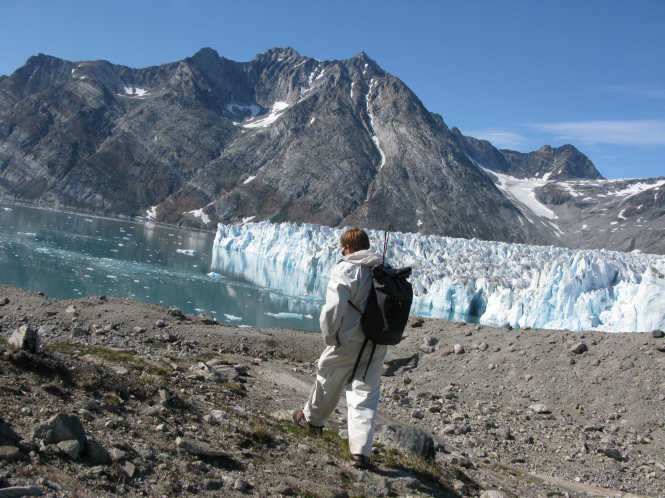
The most informative part of my experience came when I traveled to eastern Greenland to witness the calving of glaciers. Yes, climate change was evident. But as we sped through iceberg-filled waters, my Inuit guide asked whether I was visiting because my grandfather had been a soldier.
I had no idea what he was talking about.
Frozen to the small boat and regretting my decision to leave my winter coat in New York City, I listened.
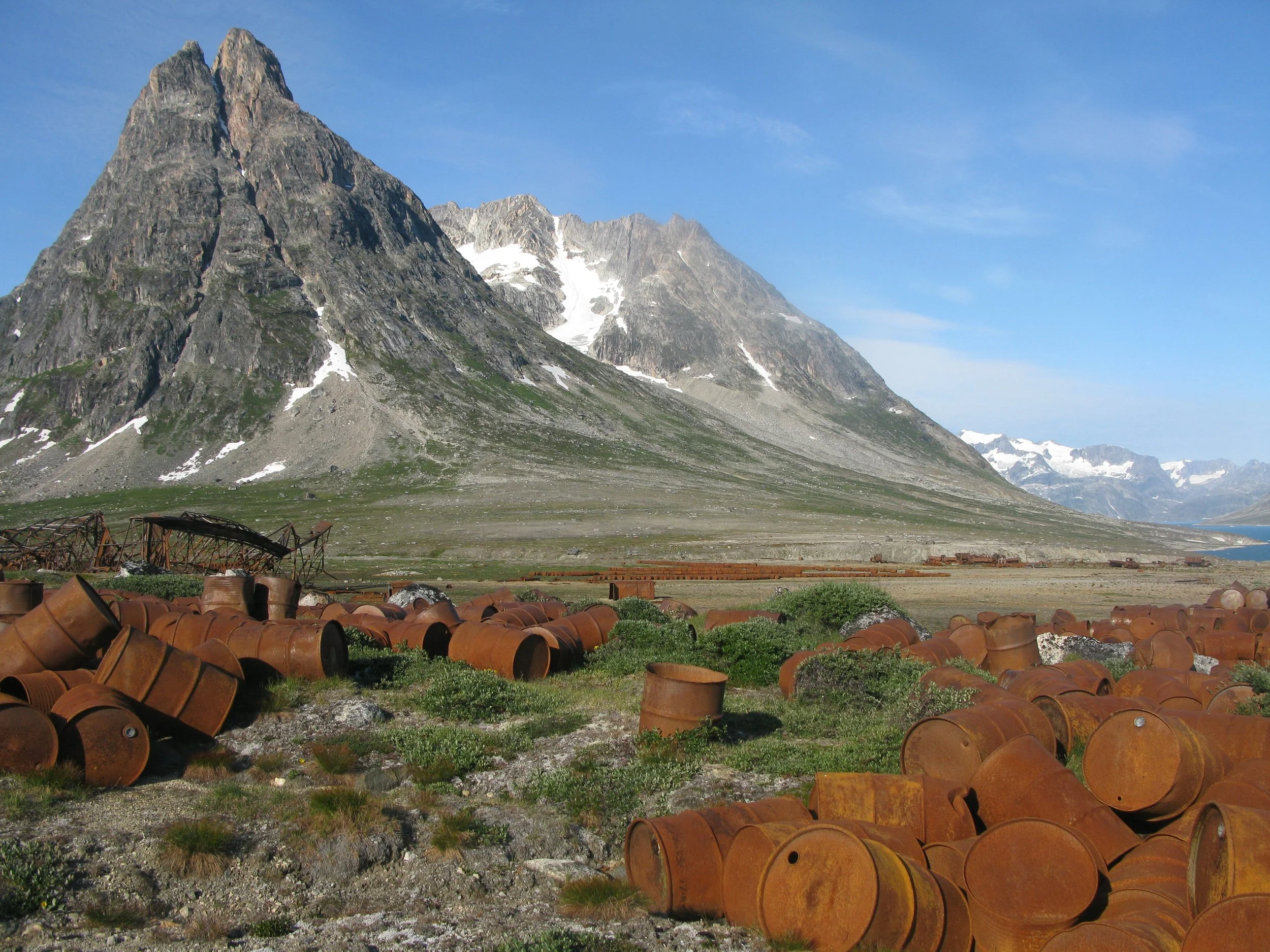
What I discovered shocked me. Scattered across the landscape were more than 10,000 fuel-filled barrels and abandoned military equipment left behind from the American World War II airbase Bluie East Two. After more than seventy years of rusting in place, the toxic mess had become an international argument over who should clean it up.
No wonder some Icelanders and Greenlanders felt the way they did about Americans: used, abandoned, and dismissed.
Sometimes you learn more about yourself—and your country—through the eyes of others.
This is the kind of introspection I try to create in my work. I examine the residue of social engineering within America’s divided landscape. I look for connections between past sociopolitical events and their present-day applications. My pieces function like souvenirs from our partisan political theater. Complete with surface and structural defects, their inexactness invites multiple interpretations. I see this ambiguity as the foundation of the bubblegum logic that fuels the consumption of our divisions.
Now, working at the collegiate level and experiencing the Deep South for the first time, Kornfield Kounty has become my current stage set.
I finally understand why Hee Haw was on television on Saturday nights.
I still don't like it.
"Who controls the past controls the future. Who controls the present controls the past."
— George Orwell, 1984
Testify — Rage Against the Machine